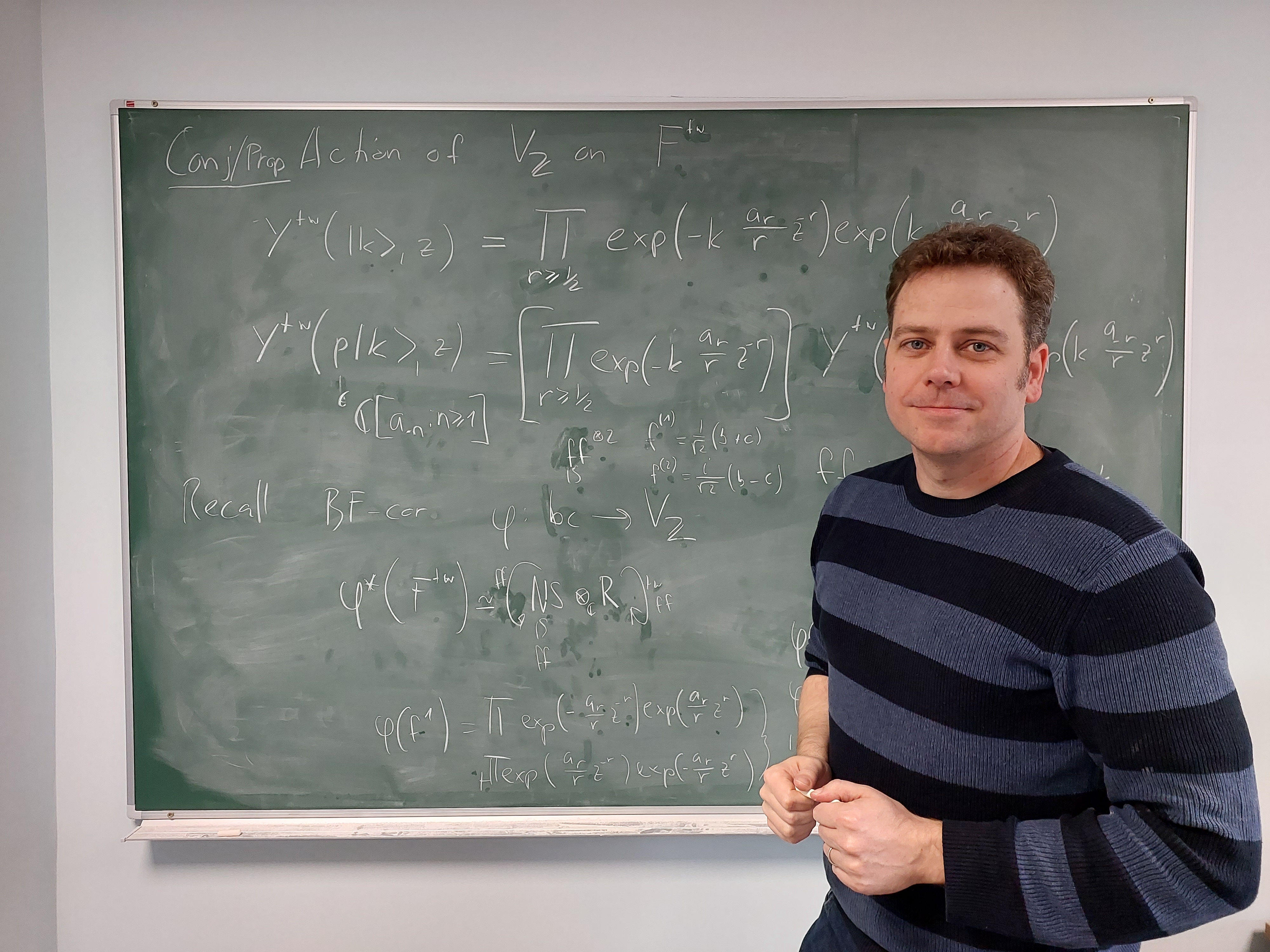
Research
Most of my work focuses on the rigorous algebraic underpinnings of two dimensional conformal field theory in the form of vertex operator algebras and tensor categories.
Conformal symmetry
The algebraic axiomatisation of the symmetries underlying a two dimensional conformal field theory is called a vertex (operator) algebra. Vertex algebras can be thought of as a kind of generalisation of associative commutative algebras but different from associative non-commutative algebras. As with associative algebras, much can be learnt from studying modules and many questions in the study of conformal field theory boil down question in vertex algebra module theory.
The most studied vertex algebras are the so called rational vertex algebras. These are distinguished by the fact that their categories of modules are semisimple with only a finite number of isomorphism classes of simple modules. I focus on vertex algebras for which neither the semi-simplicity nor the finite number of simple modules assumption need hold. Vertex algebras for which the semi-simplicity assumption fails are called logarithmic vertex algebras and the conformal field theories associated to them are called logarithmic conformal field theories. Some big endeavours in this context include module classification, analysing the additional structures that these modules admit (characters, fusion products, Verlinde formulae, etc) and finding the right abstract categorical tools which will enable a general structure theory.
My work on vertex algebra module classification makes use of certain associative algebras, called Zhu algebras, which encode a lot of information about vertex algebra module theory. Zhu algebras are notoriously hard to work with in practice and I have developed methods which recast hard Zhu algebra questions into comparatively easier questions in terms of the combinatorics of symmetric functions. Some representative publications in this line of research include:
- Admissible level \(\mathfrak{osp}(1\vert2)\) minimal models and their relaxed highest weight modules
- Superconformal minimal models and admissible Jack polynomials
- Relaxed singular vectors, Jack symmetric functions and fractional level \(\widehat{\mathfrak{sl}}(2)\) models
- From Jack polynomials to minimal model spectra
- On the extended \(W\)-algebra of type \(\mathfrak{sl}_2\) at positive rational level
Categories of modules over rational vertex algebras are so called modular tensor categories. Among many other things, this implies that the much celebrated Verlinde formula holds. This formula relates the fusion product of modules (a kind of tensor product) to an action of the modular group, \(\mathsf{SL}(2,\mathbb{Z})\), on module characters. My work aims to generalise this Verlinde formula to logarithmic vertex algebras. Some representative publication in this line of research include:
- Admissible-level \(\mathfrak{sl}(3)\) minimal models
- An admissible level \(\widehat{\mathfrak{osp}}(1\vert2)\)-model: modular transformations and the Verlinde formula
- On Regularised Quantum Dimensions of the Singlet Vertex Operator Algebra and False Theta Functions
- The Verlinde formula in logarithmic CFT
- Bosonic Ghosts at \(c=2\) as a Logarithmic CFT
- Modular Transformations and Verlinde Formulae for Logarithmic \((p_+,p_−)\)-Models
Vertex algebras and their modules are infinite dimensional vector spaces (with much additional structure). This means that it is very easy to get lost in technical details. Category theory is the perfect antidote to this as it ignores the internal structure of objects being studied and tries to understand them solely via the maps between objects. So while vertex algebra modules are infinite dimensional, the spaces of maps between them are usually finite dimensional, so this is a large reduction of complexity, if one can find the correct categorical tools. The following papers show that certain logarithmic vertex algebras, with well-chosen categories of modules, admit structures that are as rich as those of rational vertex algebras.
- Fusion rules and rigidity for weight modules over the simple admissible affine \(\mathfrak{sl}(2)\) and \(N=2\) superconformal vertex operator superalgebras
- Bosonic ghostbusting - The bosonic ghost vertex algebra admits a logarithmic module category with rigid fusion
- The tensor structure on the representation category of the \(W_p\) triplet algebra
While categories of modules over vertex algebras will not be modular tensor categories, if the vertex algebra is not rational, they still admit many rich structures that generalise those of modular tensor categories. Recent work of mine shows that categories of modules over vertex algebras admit a duality structure called Grothendieck-Verdier duality. Exploring the implications of this duality structure was one of the main aims of a recent Humboldt Fellowship project that I undertook at Hamburg University.
- Grothendieck-Verdier module categories, Frobenius algebras and relative Serre functors
- Grothendieck-Verdier duality in categories of bimodules and weak module functors
- Duality structures for representation categories of vertex operator algebras and the Feigin–Fuchs boson
Connections to integrability
As mentioned above symmetric functions have proved immensely helpful in module classification problems for vertex algebras. However, they are also ubiquitous in integrable models and are believed to be the source of a large family of correspondences between integrable models and vertex algebras. I have a joint EPSRC funded project with Prof. Christian Korff of the University of Glasgow that aims to fully understand and systematise these correspondences.
Symmetric functions were also key to joint work with Prof. Gandalf Lechner and Dr. Ulrich Pennig on Yang-Baxter equations. The Yang-Baxter equation is remarkably ubiquitous throughout mathematical physics and some areas of pure mathematics. In its simplest parameter independent form it is equivalent to the braid relation of the braid group. Solutions to the Yang-Baxter equation therefore give rise to representations of the (infinite) braid group. There is still much that is unknown about braid group representations and so the Yang-Baxter equation has the potential to be a great source of interesting representations. In Yang-Baxter representations of the infinite symmetric group all such representations which in addition satisfy that they are unitary representations of the infinite symmetric group were classified.